

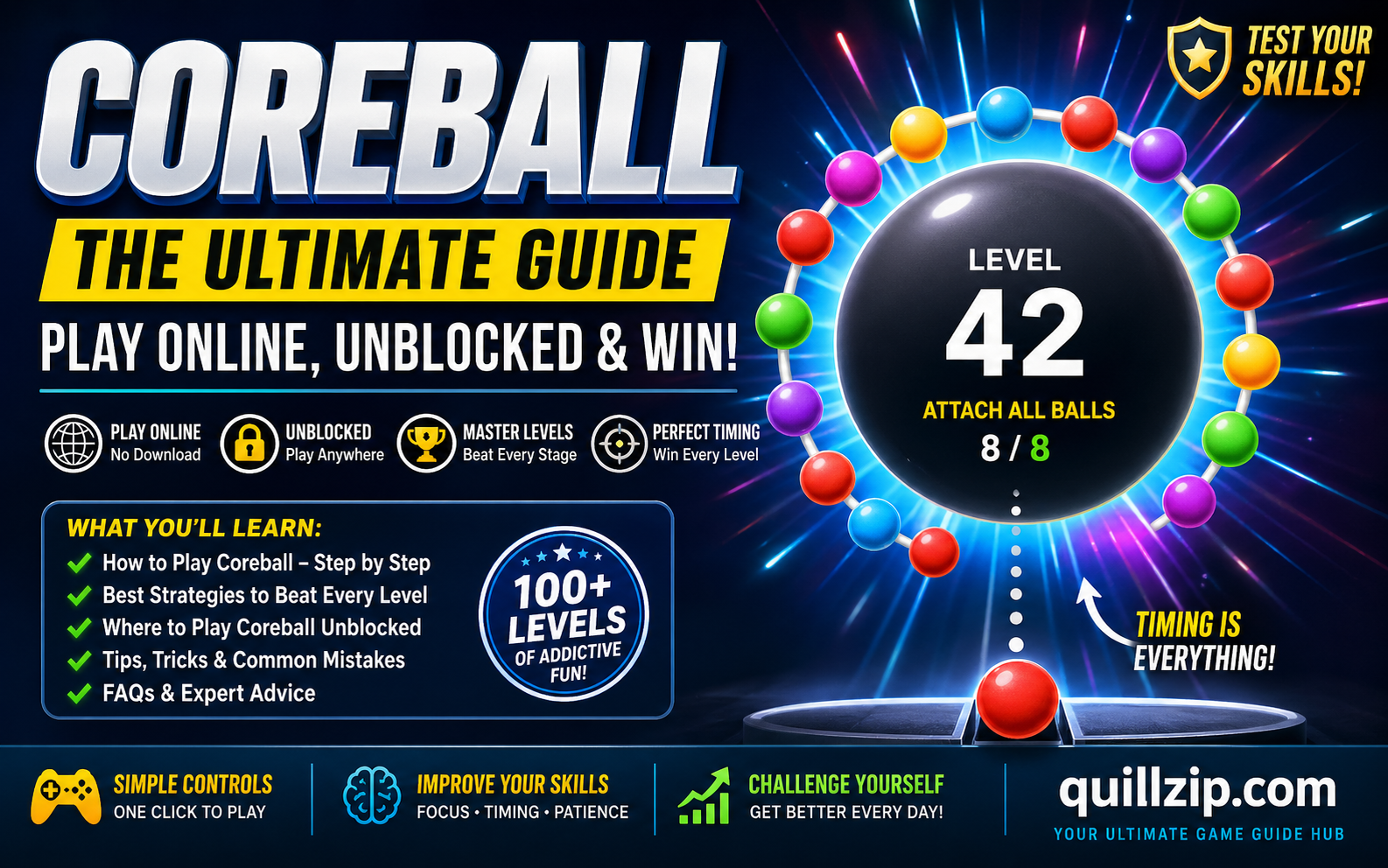
Coreball is a free, browser-based arcade game that has quietly built one of the most loyal player communities in casual gaming. Originally launched in 2015 with just 60 levels, the coreball game has since expanded to hundreds of levels across multiple hosting platforms. The objective is deceptively simple: throw small balls onto a spinning core without hitting the ones already attached. One wrong move resets the level. This single rule is what makes the game so addictive. Players aged from school students to working adults access coreball online daily for quick gaming sessions that sharpen reflexes and test patience. The game requires no download, no account, and no payment — just a browser and a willingness to learn from your mistakes.
If you have ever found yourself killing ten minutes that somehow turned into two hours, you already understand the pull of a well-designed casual game. Coreball is exactly that kind of game. It is a minimalist, browser-based arcade challenge that keeps bringing players back because of how perfectly it balances simplicity with difficulty. You do not need a powerful PC, a gaming console, or even a decent internet connection to enjoy it. All you need is a browser and a little patience.
This guide covers everything you need to know about the coreball game — what it is, how to play it, where to find coreball unblocked versions, winning strategies for every level, and answers to the most common questions new players ask. Whether you are picking it up for the first time or looking to push past the levels that have been frustrating you, this article has you covered.
What Is Coreball? A Quick Introduction
Coreball is a free online arcade game built around a single mechanic: launching small balls onto a large spinning core. Every ball you throw sticks to the core on contact and starts rotating with it. Your job is to attach all the available balls without letting any of them crash into a ball already on the core. The moment two balls collide, the level resets and you start over.
This type of game belongs to the skill and precision genre. It shares some DNA with classic arcade titles built around timing and spatial awareness, but it strips away everything non-essential. There are no power-ups to collect, no storylines to follow, and no secondary mechanics to learn. The entire experience comes down to one repeated action: watch the rotation, spot a gap, and throw at exactly the right moment.
The game first appeared in 2015 and quickly gained a following among casual players. According to the original host at arealme.com, the initial release included 60 levels. Within weeks, 30 more were added to meet demand. Today, depending on which platform you visit, you can find versions offering anywhere from 91 to over 500 levels. This expansion happened organically as different sites recognized just how popular the game had become.
Part of what made coreball so widely played is the unblocked factor. Because it runs entirely inside a browser tab and requires no installation, it became a staple in schools and offices where software downloads are restricted. Search interest in coreball unblocked grew steadily as students and workers discovered it was easy to access anywhere.
How to Play Coreball – Step-by-Step for Beginners
Getting started with the coreball game is genuinely straightforward. The controls are as simple as a game can get, which is one of the reasons it appeals to such a wide audience. Here is a clear step-by-step walkthrough to get you from zero to your first cleared level.
Step-by-Step Guide
- Open your browser and go to any coreball hosting site such as arealme.com, coreball.co, or coreball.cc. The game loads instantly in your browser window with no installation required.
- You will see a large circle at the center of the screen — this is the core. A number displayed on screen tells you how many small balls you need to attach to complete the level.
- Below the core, you will see a ball ready to be launched. On desktop, click anywhere on the screen (or press the spacebar on some versions) to throw the ball toward the core. On mobile, tap the screen.
- The ball flies upward and sticks to the edge of the core wherever it lands. Watch where it lands relative to the balls already attached.
- Continue launching balls one at a time. Between each throw, watch the core rotate and wait for a clear gap between existing balls before you launch the next one.
- If your launched ball touches any ball already on the core, the level resets. You start that level again from scratch with a fresh count of balls.
- When all balls are successfully attached without a collision, the level clears and you advance to the next one automatically.
- Each subsequent level increases in difficulty. The core may spin faster, you may have more balls to place in a tighter space, or both.
Controls at a Glance
- Desktop: Click the mouse button or press spacebar to launch a ball
- Mobile: Tap anywhere on the screen to launch
- No joystick, no keyboard navigation, no complex inputs required
- Timing is the only real skill you need to develop
The beauty of these controls is that they put the entire focus on timing rather than dexterity. You are not managing a character across a map or memorizing button combinations. You are watching, waiting, and clicking at the right moment. This is precisely why the coreball game appeals to casual players and serious gamers alike.
Where to Play Coreball Online – Best Platforms
One of the most searched questions about this game is where to find a reliable place to play coreball online. Because the game has no single official owner and has been hosted by dozens of sites since 2015, players sometimes land on outdated or cluttered versions. Here is a rundown of the most popular and reliable options available right now.
Top Platforms for Coreball
- arealme.com/coreball – Considered the original browser version, this site has been running the game since 2015 and regularly updates its level count. It also tracks global stats and speedrun records, giving competitive players a reason to keep coming back.
- coreball.co – A dedicated coreball site with a clean interface and over 450 levels. It is well-maintained and preserves the original physics that made the game popular.
- coreball.cc – A popular destination for both desktop and mobile players. Clean layout, no excessive ads, and loads quickly even on slower connections.
- HoodaMath – One of the most well-known educational gaming sites. HoodaMath hosts coreball unblocked in a format that is specifically designed to be accessible from school networks. The site frames games within a learning context, which is why many schools do not block it.
- cpstest.org/coreball-game – Another solid host with a good version of the game and easy browser loading.
All of these sites let you play coreball online for free without creating an account or providing any personal information. The game simply loads in the browser and you start playing immediately.
Coreball Unblocked – How to Access It Anywhere
The term coreball unblocked refers to versions of the game that can be accessed on restricted networks — most commonly school or workplace networks that block gaming websites. This has been one of the most searched phrases associated with the game, which tells you quite a bit about the player demographic.
Because coreball is an HTML5 browser game with no downloads or external plugins, it can run on virtually any device with a web browser. Most schools block specific domains rather than game mechanics, so the trick is finding a hosting site that has not been added to the school’s block list.
Ways to Access Coreball Unblocked
- Use an educational gaming site like HoodaMath, which is often whitelisted on school networks because of its academic framing
- Search for mirror sites or alternative hosts of the game — because so many sites run coreball, at least one is likely to be accessible on most networks
- Access the game on a mobile device using mobile data rather than the school or work WiFi
- Use a reputable VPN service if your school or employer permits it — though always check your institution’s policies before doing so
The broader point is that coreball was built to be accessible. It does not require hardware acceleration, a dedicated graphics card, or any special browser extension. Any modern browser on any device can run it, which means getting access to an unblocked version is rarely a technical challenge — it is mostly a matter of finding the right host.
Coreball Strategy – How to Beat Every Level
This is the section most players come looking for. The coreball game is easy to understand but hard to master, and that gap is where most players get stuck. Good strategy makes a real difference, especially in the later levels where the core spins fast and the spacing between attached balls gets very tight. Here are the most effective techniques that consistent players rely on.
Core Strategies for Consistent Play
- Watch Before You Throw: Never launch a ball immediately when a level loads. Spend a few seconds observing the rotation speed and identifying the existing gaps. The core follows a predictable pattern — learn it first.
- Find the Rhythm: Every level has a rhythm to it. Once you identify how fast the core is spinning, you can mentally mark the moment you need to click. Experienced players describe this as syncing with the game rather than reacting to it.
- Aim for Wide Gaps: When multiple gaps are available, always target the widest one. Trying to squeeze into a tight spot increases the risk of collision significantly, especially since the core does not pause between your throws.
- Slow Down Your Clicking: Rushing is the number one cause of failure in coreball. The moment you feel yourself clicking faster out of frustration, slow down deliberately. Patience directly translates to better results in this game.
- Build Toward Balance: On levels with many balls to place, try to distribute them evenly around the core rather than clustering them on one side. This keeps more gaps available as the level progresses.
- Use the Anticipation Method: Instead of clicking when a gap is directly in front of you, click just before it arrives. The ball takes a small amount of time to travel, so throwing slightly early often lands it exactly where you intended.
Level Difficulty Progression
Understanding how difficulty scales helps you mentally prepare for what is coming. The coreball game does not just make levels harder randomly — there is a clear progression pattern that most hosting sites follow.
- Levels 1 to 20: Slow rotation, few balls to place, wide gaps. These levels are designed to teach you the core mechanic.
- Levels 21 to 50: Moderate rotation speed, slightly more balls, and some levels introduce pre-attached balls that start the level already crowding the core.
- Levels 51 to 80: Noticeably faster rotation, tighter gaps, and higher ball counts. This is where most beginners hit their first wall.
- Levels 81 and beyond: Demanding timing, fast cores, and sometimes irregular rotation patterns that require extra focus. These levels reward players who have genuinely internalized the rhythm approach.
If you are stuck on a specific level, try a different approach entirely. Sometimes the gap you have been targeting is not the best one for that level. Step back, watch the full rotation a few times, and identify all available gaps before you throw your first ball.
Coreball vs Similar Arcade Ball Games – Quick Comparison
Coreball belongs to a category of precision arcade games that have become very popular as browser games. Here is how it compares to similar titles in the genre.
| Feature | Coreball | Knife Hit | Stack Ball | Geometry Dash |
| Genre | Precision arcade | Knife throwing | Ball breaking | Rhythm platformer |
| Free to Play | Yes | Yes (ads) | Yes (ads) | Paid app |
| Browser Playable | Yes | Mobile app only | Mobile app only | App + browser |
| No Download Needed | Yes | No | No | Partial |
| Unblocked at School | Usually yes | Usually no | Usually no | Sometimes |
| Core Mechanic | Timing + precision | Timing + aim | Speed + reaction | Rhythm + memory |
| Learning Curve | Low start, steep mid | Low to moderate | Moderate | Steep |
| Level Count | 100 to 500+ | Varies | Varies | 2000+ |
What separates coreball from most entries in this genre is the combination of zero friction to start and genuine skill depth once you get into the mid-levels. You can load the game in under five seconds and begin playing, but you will still be learning new techniques fifty levels in. That is a rare balance for any game to achieve.
Benefits of Playing Coreball – More Than Just Entertainment
It is easy to dismiss casual arcade games as pure time-wasting, but coreball actually offers some real cognitive benefits that are worth mentioning, especially if you are someone who likes to justify gaming as a productive use of time.
Skills the Game Develops
- Hand-Eye Coordination: Launching a ball at precisely the right moment based on what you see on screen is a direct hand-eye coordination exercise. The more you play, the more naturally this comes.
- Reaction Time: As the core spins faster in higher levels, your reactions need to sharpen. Regular play has been shown to improve general reaction time, as referenced in research on cognitive benefits of gaming via Wikipedia.
- Pattern Recognition: Identifying the rotation pattern of the core and predicting when gaps will align is a pattern recognition task. This is the same cognitive process used in many professional and academic contexts.
- Patience and Impulse Control: The game actively punishes rushing. Players who succeed are those who have developed the patience to wait for the right moment rather than clicking as soon as something looks approximately right.
- Focus Under Pressure: As you get deeper into a level with many balls already attached, the pressure increases. Maintaining focus and calm in these moments builds mental composure that transfers to other areas.
These are not trivial skills. Many educators and psychologists recognize that well-designed games can serve as low-stakes environments for developing real cognitive abilities. If you are interested in exercises that actively build these same abilities, the guide on critical thinking exercises for problem-solving covers practical methods that pair well with the mental habits coreball naturally trains. Coreball, with its precision-focused gameplay, is a good example of a simple game that still engages the brain meaningfully.
Coreball Game Tips for Different Player Types
Not every player comes to coreball with the same goals. Some want to race through levels as fast as possible. Others want to find their personal rhythm and enjoy the meditative quality of the game. Here are tailored tips based on what you are trying to get out of it.
Complete Beginners: Where to Start
- Focus entirely on levels 1 through 10 until you feel comfortable with the timing before moving forward
- Do not worry about your score or completion speed in the early stages
- Play on a desktop browser first if possible — the larger screen makes it easier to read the rotation and judge gaps
- Take a breath before each throw rather than launching the moment you load a level
For Intermediate Players Stuck on Mid-Game Levels
- Stop trying to replicate what worked on earlier levels — mid-game levels often need a different mental approach
- Deliberately slow your throw rate even if it feels uncomfortable at first
- Target the gap directly opposite from the largest cluster of attached balls
- Watch a full rotation at least twice before throwing your first ball on any level that has stumped you
For Players Chasing High Level Completions
- Use the replay level feature (available on some platforms) to study the rotation pattern before committing to a full run
- Build a consistent pre-shot routine — the same pause, the same mental focus trigger before every throw
- Accept that occasional resets are part of the game, not failures. The players with the best completion rates are usually the ones who reset calmly rather than grinding in frustration
Technical Information – How Coreball Works
Coreball is built with HTML5 and JavaScript, which is why it runs natively in any modern browser without plugins or downloads. HTML5 canvas-based games like coreball use the browser’s built-in rendering engine to handle graphics and physics, which makes them lightweight and fast to load even on modest hardware.
The physics of the game are deliberately simple. The core rotates at a consistent speed per level, with no acceleration mid-level. Balls attach to the exact point where contact is made and then rotate with the core at the same speed. This consistency is what makes it possible to learn and internalize timing — if the physics were randomized, strategy would become impossible.
The game was designed by developer Ben Vinegar, who built the original version as a skill-based browser game. The simplicity of the concept meant it was easy to port and host, which is why dozens of independent sites have created their own versions over the years.
Interestingly, the browser-first approach that coreball pioneered mirrors a broader trend in casual gaming where accessibility matters more than raw graphics. For another perspective on how browser-compatible and Android-based games have evolved, the Valan Slap845 platform guide is a useful comparison point on how different casual game formats handle version updates and player compatibility.
For those curious about the broader landscape of browser gaming and where coreball fits historically, the Wikipedia article on browser games provides useful context on how HTML5 replaced Flash as the dominant technology for this category.
Common Mistakes Players Make in Coreball
Understanding what not to do is sometimes more useful than knowing what to do. Here are the most common mistakes that hold players back, especially in the mid and late stages of the game.
Mistake 1: Throwing Too Fast
The single most common mistake is rushing throws, especially after a reset. When frustration kicks in, the instinct is to click faster, but faster clicking in coreball almost always leads to more collisions. Slow down after every reset and give yourself a deliberate pause before the first throw.
Mistake 2: Not Watching the Full Rotation
Many players throw at the first gap they see without checking whether a better gap will open up two seconds later. Taking the time to watch a full rotation before throwing can significantly reduce collisions.
Mistake 3: Ignoring Pre-Attached Balls
Some levels start with balls already on the core. New players sometimes forget about these when planning their first throw. Always account for every ball on the core, including ones that were there when the level started.
Mistake 4: Playing on a Small Screen Without Adjusting
Playing coreball on a very small phone screen without zooming in can make it hard to judge gaps accurately. If you are playing on mobile and finding collisions that do not seem fair, try rotating to landscape mode or zooming slightly to get a clearer view of the core.
Mistake 5: Giving Up on Difficult Levels Too Quickly
Some levels genuinely have a steep difficulty spike. This is normal. Most of the time, the solution is a small adjustment to your approach rather than a completely different strategy. If you have been stuck on a level for a while, take a short break, come back, and try watching the rotation without throwing for two or three full cycles before your first attempt.
Coreball and the Broader World of Arcade Ball Shooting Games
Coreball sits within a larger category of arcade ball shooting games that have consistently attracted massive audiences on both mobile and browser platforms. This genre has roots going back to classic titles like Bubble Shooter, which popularized the idea of aiming and launching balls under time or spatial pressure. Coreball strips that formula down to its essence — no colors to match, no chains to complete, just pure timing.
What these games share is an accessibility that most AAA titles do not have. They can be picked up in thirty seconds, played for five minutes, and put down without losing progress in a meaningful way. For players who do not have time for a full gaming session but still want the satisfaction of a skill-based challenge, arcade ball games fill that gap perfectly. This same appetite for free, no-friction online entertainment also drives platforms in other categories — for example, the detailed breakdown of how free online streaming platforms work shows how the zero-barrier model applies far beyond gaming.
Coreball also benefits from the same qualities that made hyper-casual mobile games explode in popularity after 2015. Games with one perfect mechanic, zero friction to start, and genuine depth for players who choose to invest time — these titles consistently punch above their weight in terms of player retention and community growth.
Frequently Asked Questions About Coreball
1. What is coreball?
Coreball is a free online arcade game where you launch small balls onto a spinning core without hitting the balls already attached. It is a browser-based, single-mechanic skill game that tests your timing and precision.
2. How do you play coreball?
You click or tap the screen to launch a ball toward the rotating core. The ball sticks to the core wherever it lands. Your goal is to attach all available balls without letting any of them collide with one already on the core. A collision resets the level.
3. How many levels does coreball have?
The level count varies depending on which platform you use. The original browser version launched with 60 levels in 2015. Different hosting sites have expanded this independently — some offer 91 levels, others over 500. The original host at arealme.com has updated their version to over 500 levels as of early 2025.
4. Is coreball free to play?
Yes. Coreball is completely free on every platform that hosts it. There are no in-app purchases, premium tiers, or subscription fees. Some sites display ads, but the game itself has no cost.
5. Can I play coreball unblocked at school?
In most cases, yes. Because coreball is a browser game with no download required, many hosting sites are accessible on school networks. Sites like HoodaMath specifically host it in an educational context, which means they are less likely to be blocked. If one site is blocked, try another host.
6. Does coreball work on mobile?
Yes. The game uses HTML5 and works on any modern mobile browser. You tap the screen to launch balls instead of clicking. Some players prefer mobile because the touch input feels more natural for this type of game.
7. Who created coreball?
The coreball game was designed by developer Ben Vinegar. It was originally released in 2015 as a browser-native precision arcade game and has since grown through various hosting platforms that have independently expanded its level count.
8. Why do I keep losing in coreball?
The most common cause of repeated losses is throwing too fast. Coreball rewards patience above almost everything else. Wait for a clear gap, watch the full rotation before your first throw, and resist the urge to click quickly after a reset.
9. What is the best strategy for hard levels?
For difficult levels, slow your throwing pace, watch at least two full rotations before throwing your first ball, and aim for the widest available gap rather than trying to squeeze into a tight space. If a level continues to stump you, try targeting a different gap entirely than the one you have been using.
10. Are there different versions of coreball?
Yes. Because the game has been hosted independently by many sites since 2015, there are slight differences between versions. Some have more levels, some have slightly different visual styles, and a few have added features like level selection for previously completed stages. The core mechanic remains the same across all versions.
11. Is coreball good for kids?
Yes. The game has no violent content, no inappropriate material, and is age-appropriate for all ages. Its focus on timing and precision also gives it mild educational value, making it one of the more parent-friendly options in the casual gaming space.
12. Can I compete against other players in coreball?
Some platforms, particularly arealme.com, have added global stats and speedrun records that allow players to compare their performance. While the core game is single-player, this competitive layer gives dedicated players something extra to chase.
Conclusion
Coreball is proof that a game does not need to be complicated to be genuinely engaging. It has one rule, one control, and one clear goal — and yet it has maintained a dedicated following for over a decade by executing that single idea with precision. The combination of an ultra-low barrier to entry, no cost, and genuine skill depth makes it one of the best casual games available in a browser right now.
Whether you are looking to burn five minutes between meetings or commit to clearing all available levels, the coreball game scales to whatever you want from it. Beginners will enjoy the early levels immediately. More experienced players will find the later stages genuinely challenging and rewarding to crack.
The strategies in this guide — watching full rotations before throwing, aiming for wide gaps, slowing your pace after resets, and building a consistent rhythm — apply from level one all the way to the most demanding stages. They are not tricks or shortcuts. They are the core habits that separate players who get stuck from those who keep advancing.
If you have not tried it yet, load up coreball online in your browser right now. It takes about thirty seconds to start and costs nothing. The only thing you have to lose is the next two hours to a surprisingly addictive arcade game. And if you enjoy discovering games like this one, the Gaming section on QuillZip covers more titles and guides worth exploring.
